
Files & Polishing Pads
Pro Tip: When choosing a polishing pad, look for diamond ceramic bond instead of traditional resin, this advanced composition offers heat resistance, making them ideal for both wet and dry applications.
When you need to smooth, polish, or finish a surface, it is important to know the difference between polishing pads, diamond sanding blocks, and files.
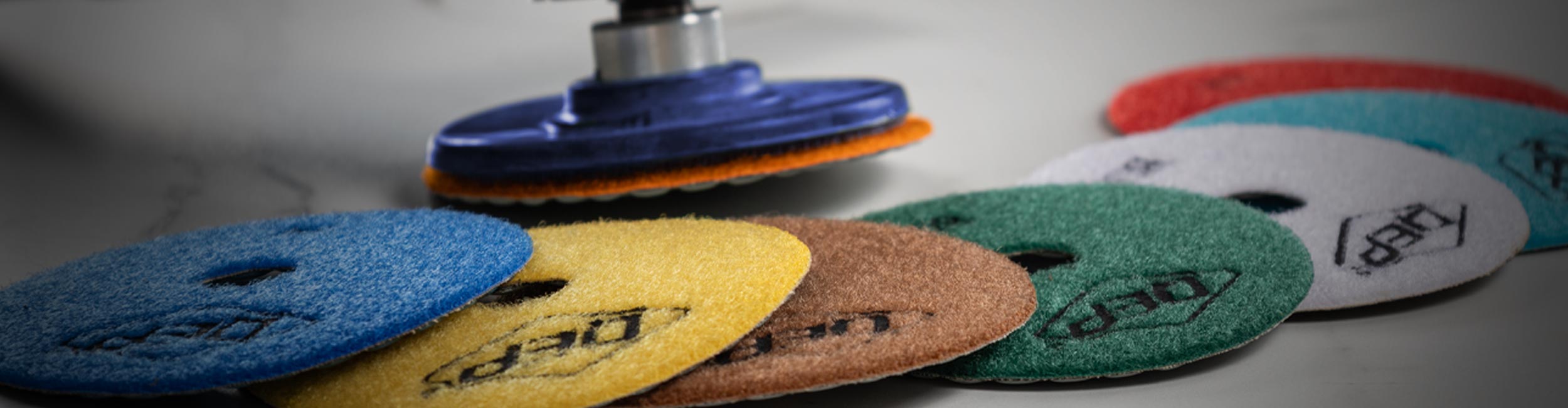
Polishing pads are versatile tools to smooth tile, stone, granite, glass, ceramic, and marble. They are attached to high-speed power tools, usually grinders, to work on large areas, while sanding blocks are handheld foam blocks designed for manual, detailed, or corner finishing.
Polishing pads are used with angle grinders or polishers, and are best to work on large, flat surfaces like countertops, slabs, or floors.
Diamond sanding blocks are designed for manual sanding and detailing, and they are best suited for touch-ups, manual blending, hard-to-reach areas, and breaking sharp edges.
Here are key factors to keep in mind when buying polishing pads for grinders:
- Maximum RPM: Ensure the pad's maximum RPM matches your grinder, and make sure to choose the proper thickness for the task ahead.
- Diamond Bonding Pattern: The diamond pattern on the surface of the polishing pads is critical because it determines the aggressiveness, material removal rate, the lifespan of the pad itself, and final finish quality.
- Diamond Ceramic Bond: Look for diamond ceramic bond instead of traditional resin, this advanced composition offers heat resistance, making them ideal for both wet and dry applications.
- Grit Matters: Make sure to select the proper grit for the job. The 800 grit is ideal for medium smoothing and buffing, the 1500 grit, 3000 grit, and buffing pad are best final finishing.
- Backing Pad: Backing Pads have the sole purpose of holding the polishing pads in place, securing the polishing pad to the tool for a consistent, even finish. A 5/8"–11 threaded connection for direct attachment to grinders and electric polishers is always recommended.
- Hook & Loop Backing: Polishing pads designed with hook and loop backing ensure quick and secure attachment to the backing pad.
Keep in mind that if the job ahead involves touching up and detailing small areas – sanding blocks might be the best choice.
Here are key factors to keep in mind when buying diamond sanding blocks:
- Design Matters: Foam-backed sanding blocks with electroplated diamond offer great durability and are specially designed for comfort in hand.
- Speed: Slow, precise manual pressure.
- Flexibility: The stiff foam base is designed to help keep the edges flat, while allowing you to maneuver around the areas and perimeters with precision.
- Versatility: These hand-held sanding blocks are your best bet for smoothing ceramic, tile, glass, or stone edges after cutting.
Regarding diamond grit files and rubbing stones:
These are essential tools to keep in the toolbox. Make sure to get a grit file that offers a combination flat/round design to smooth straight edges, as well as internal and external curves.
An added convenience of a diamond grit file is that you can use it to smooth other materials, like laminate flooring and backer board.
Lastly, a sanding & rubbing stone is always handy when it comes to smoothing rough edges on freshly cut tiles. Sanding and rubbing stones are designed to fit comfortably in your hand for ease of use. Make sure to get one that features 60 and 80 grit surfaces for medium and fine abrasion.
This collection is empty
Continue shopping